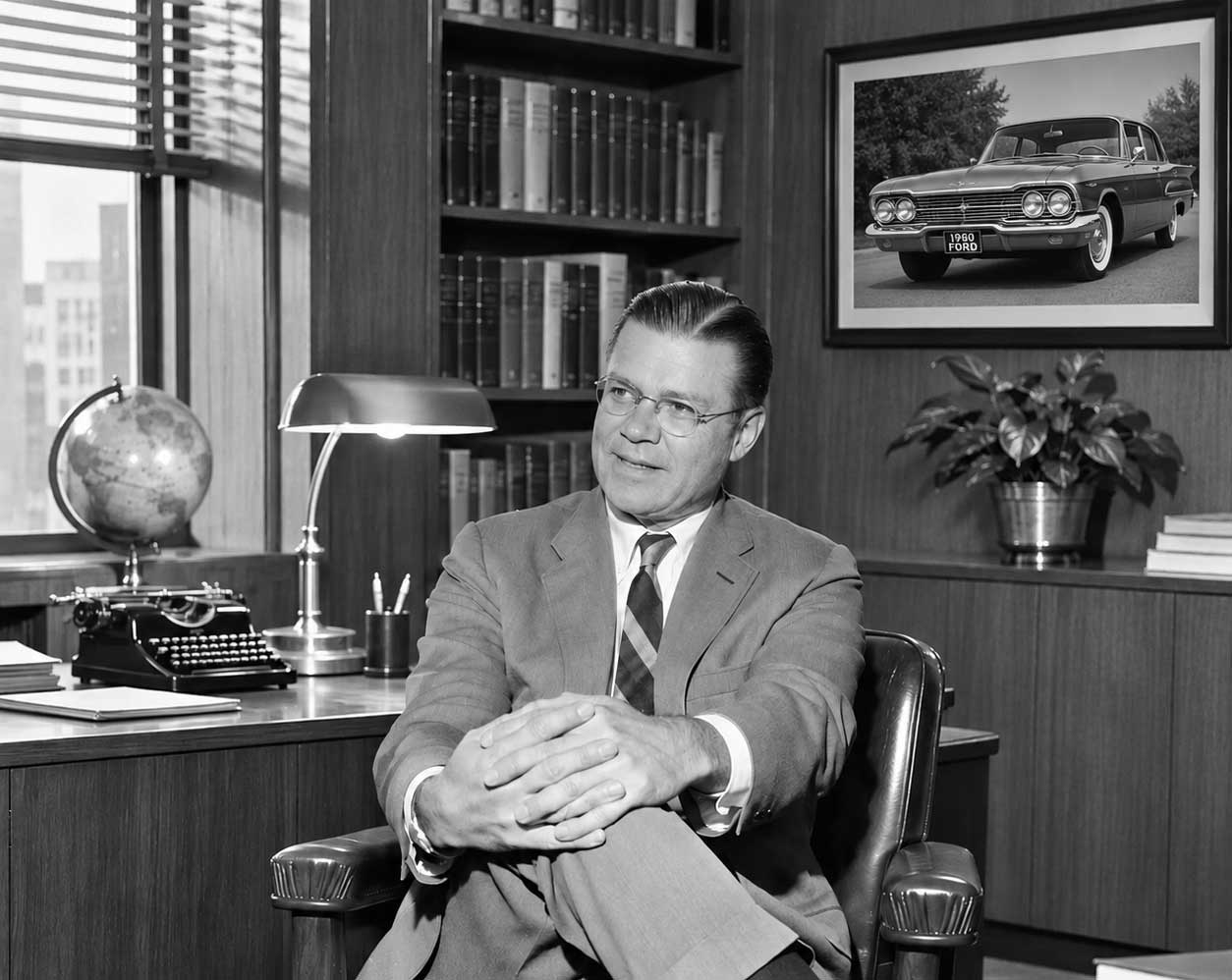
On 9 November 1960, Robert S. McNamara was named President of Ford Motor Company, becoming the first person outside the Ford family to hold the position since John S. Gray, the company's inaugural president. His appointment marked a significant departure from Ford's traditional leadership structure. Yet the man entrusted with one of America's largest automotive enterprises would remain in the position for barely five weeks, before an unexpected invitation took him from Detroit to Washington.
From War Rooms to Boardrooms
McNamara's journey into the automotive industry began far from the factory floor. Born in San Francisco in 1916, he studied at the University of California, Berkeley, and Harvard Business School before serving in the US Army Air Forces during the Second World War. There, he applied statistical analysis and management techniques to improve military operations.
In 1946, he joined Ford as one of ten former military officers recruited to modernise the company's management practices. Nicknamed the Whiz Kids, the group introduced systematic financial controls, performance measurement and analytical decision-making into an organisation historically shaped by the instincts of its founder.
McNamara quickly distinguished himself, rising through finance, planning and operational management to become a senior executive. His approach challenged conventional automotive thinking, placing greater emphasis on cost efficiency, product strategy and measurable commercial performance.
His influence was particularly evident in the Ford Falcon, introduced in 1959 as a compact, economical alternative to America's increasingly large automobiles. The Falcon demonstrated that practicality and affordability could remain powerful selling points in a market dominated by size and horsepower.
McNamara also championed vehicle safety, supporting Ford's introduction of the Lifeguard safety package for the 1956 model year. Its features included seat belts, a dished steering wheel and padded instrument panels, reflecting a growing recognition that occupant protection deserved greater attention in automobile design.
A Presidency that Lasted Five Weeks
McNamara's appointment in November 1960 represented a milestone in Ford's corporate evolution. For the first time in more than five decades, the presidency had passed beyond the founding family, demonstrating the increasing importance of professional management in the modern automotive industry.
But his tenure was unexpectedly brief.
In December 1960, President-elect John F. Kennedy invited McNamara to become US Secretary of Defense. He accepted, leaving Ford after approximately five weeks as president. On 21 January 1961, he assumed responsibility for one of the most powerful departments in the American government.
His subsequent political career would become far more controversial than his years in Detroit, particularly because of his role in the Vietnam War. Yet his contribution to Ford remains a distinct chapter in automotive management history.
McNamara helped demonstrate that an automobile manufacturer could be guided not only by engineering expertise and entrepreneurial instinct, but also by rigorous analysis, financial discipline and strategic planning.
His presidency was measured in weeks. His influence on Ford's management philosophy had been developing for nearly fifteen years.